As America marks its 250th anniversary, Duval County is opening a window into the often-unseen work that keeps democracy functioning. A new free exhibition, “Democracy Starts Here: From Ballots to Belonging,” explores how democracy is built at the local level and highlights the role of local election offices, poll workers, election officials, and voters in shaping and sustaining democratic participation.
The exhibition, housed in a 1,200-foot facility located on Imeson Park Boulevard, Building 100, was born out of the passion of Election Supervisor, Jerry Holland. Holland explained that the exhibit emphasizes the idea that democracy begins in local communities and election offices and aims to connect the history and evolution of voting and civic participation.
“I feel we have a good start in educating people on the voting history and process,” Holland told Eye on Jacksonville. “We want this exhibit to inspire an appreciation as to why we need to vote. Hopefully, it will encourage other counties to think about doing this.”
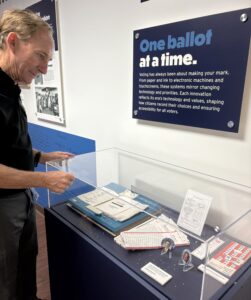
Items displayed in the exhibit began with the finding of 67 stored boxes that contain voting documents dating back to the 1930s. With the help of community collaboration and partnerships that include Museum of Science and History (MOSH), Jacksonville History Center, Jacksonville Public Library, University of North Florida Special Collections & University Archives, and the Florida Times-Union, the exposition now features more than 50 artifacts and historic images.
The artifacts in the exhibit span more than 150 years of election history and serve as both a history lesson and a call to civic participation. It is a reminder that democracy is not an abstract concept, but a system sustained by ordinary citizens and local institutions every day.
Signature items include mechanical lever voting machine, a “hanging chad” display recalling the contentious 2000 election, voting systems spanning the 2000s through the 2020s, a 1930 Duval County district map, and a 1933 primary election sample ballot.
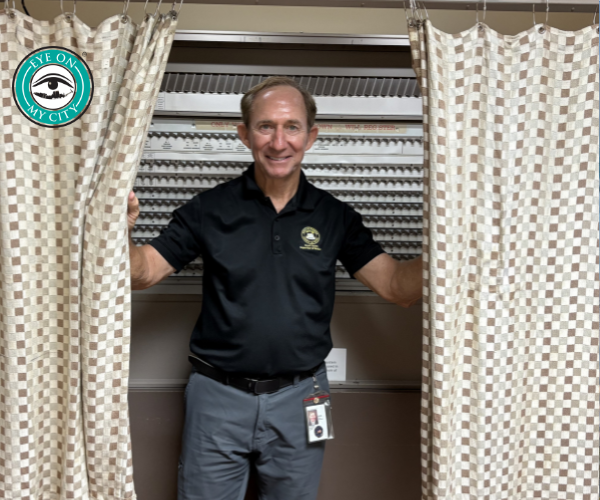
The mechanical lever voting machine was once a familiar sight in polling places across the country. Introduced in the late 19th century and used extensively throughout the 20th century, these machines allowed voters to cast ballots by pulling levers instead of marking paper ballots. The machine on display offers visitors a hands-on look at how elections were conducted before the rise of computerized voting systems. Its intricate gears, counters, and curtain mechanism demonstrate the ingenuity of earlier election technology while underscoring the ongoing evolution of ballot security, accessibility, and vote tabulation. Positioned alongside modern voting equipment, the machine provides a tangible reminder of how election administration has adapted over generations to meet the needs of voters.
The hanging chad reflects one of the most controversial chapters in modern election history. The “chad”, is a small piece of a paper that has not been completely detached when punching paper tape or cards. Hanging chads played a major role in the United States presidential election of 2000, Partially punched ballots that were not read by voting machines led to calls for a recount in Florida. The manual recounts ordered by the Florida Supreme Court were ultimately ended by the Supreme Court of the United States as a result of the case Bush Vs. Gore, and Bush was declared the winner.
The museum has also incorporated an online exhibit that allows visitors to explore the collection remotely. A teaching guide helps students, educators, and families connect historical lessons to modern civic engagement and consider their own role in shaping the nation’s future.
While the exhibit is permanent, it is open for a limited number of days and times over the next two months due to staff attending to election obligations. The exhibition is open through Oct. 16, Monday through Friday, from 10 a.m. to 3 p.m. (excluding holidays). No tickets are required. Community groups may request behind-the-scenes tours led by elections staff by visiting duvalelections.gov to fill out a Community Involvement Request Form.
Eye reminds voters that the upcoming general election is Nov. 3, followed by a primary election on March 9 and the general election on May 18.