Here is a number that should make Americans stop and think:
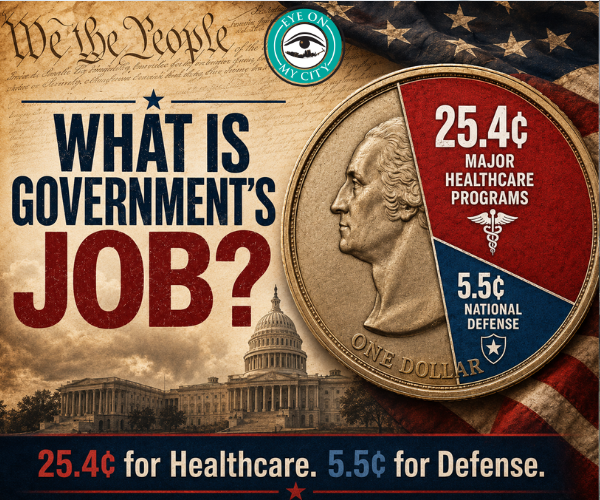
Major federal healthcare programs now consume about 25 cents of every dollar Washington spends. National defense gets about 5½ cents.
In other words, Washington spends roughly four-and-a-half times as much on major healthcare programs as it does defending the nation.
That is quite a transformation from the federal government our Founders envisioned.
James Madison wrote in Federalist No. 45 that the powers delegated to the federal government were to be “few and defined,” principally involving matters such as war, peace, foreign relations and commerce. Most matters affecting people’s everyday lives were expected to remain with the states.
So how did we get from there to here?
It didn’t happen overnight.
The federal government’s social responsibilities were added and expanded over generations:
1935 — Social Security. President Franklin D. Roosevelt signed the Social Security Act, establishing federal old-age benefits along with unemployment insurance and other assistance programs.
1956 — Social Security Disability Insurance. President Dwight Eisenhower signed legislation adding cash disability benefits to Social Security.
1964 — Food Stamps. President Lyndon Johnson’s administration made the Food Stamp Program permanent. Today we know it as SNAP.
1965 — Medicare and Medicaid. Johnson signed both programs into law, dramatically expanding Washington’s role in healthcare for seniors and lower-income Americans.
1972 — Supplemental Security Income. President Richard Nixon signed legislation creating SSI for low-income aged, blind and disabled Americans.
1997 — Children’s Health Insurance Program. President Bill Clinton signed legislation creating CHIP, expanding government-supported health coverage for children whose families earned too much for Medicaid but could not afford private insurance.
2010 — Affordable Care Act. President Barack Obama signed the ACA, further expanding the federal government’s role in health insurance and healthcare financing.
Each program came with an argument for why government should take on another responsibility. Many became extraordinarily popular. Millions of Americans now depend upon them.
But add them together over nearly a century and something fundamental changed.
The federal government created primarily to handle genuinely national responsibilities — including defending the United States — became one of the largest providers and financiers of healthcare, retirement income and economic assistance in the world.
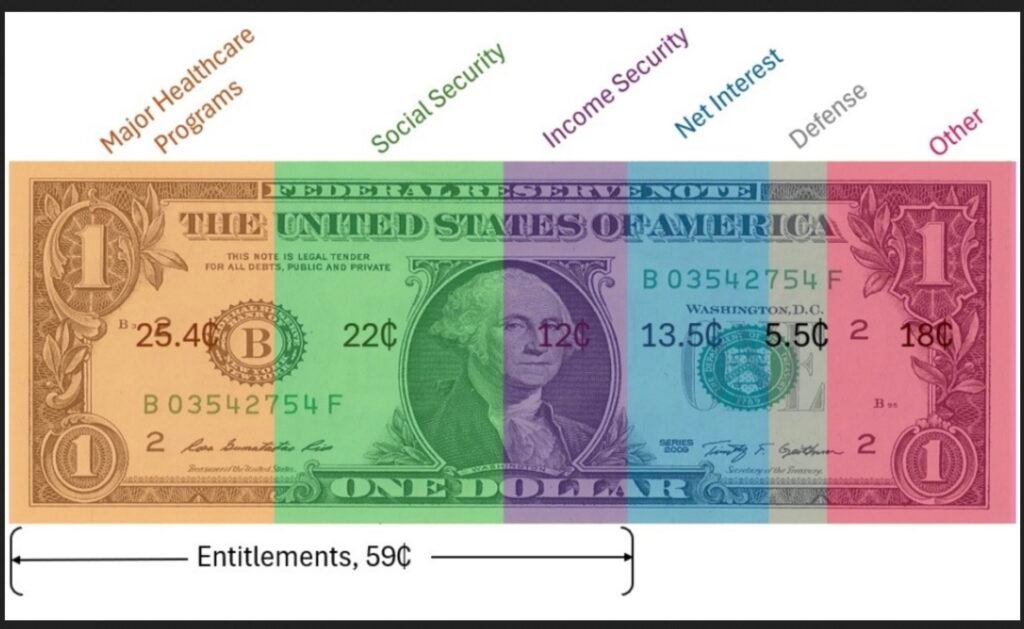
And today’s federal spending dollar shows the result.
Roughly 25.4 cents goes to major healthcare programs.
Another 22 cents goes to Social Security.
About 12 cents goes to income-security programs.
And just 5.5 cents goes to national defense.
This isn’t necessarily an argument that Medicare, Medicaid or Social Security should disappear.
It is an argument that Americans should occasionally ask a more basic question:
What is the federal government’s job?
Because somewhere between Madison’s government of “few and defined” powers and today’s Washington, the answer changed dramatically.
Maybe before arguing about the next trillion-dollar budget, we should ask whether Washington is still concentrating on the responsibilities the federal government was actually created to perform.
The numbers suggest it isn’t.